


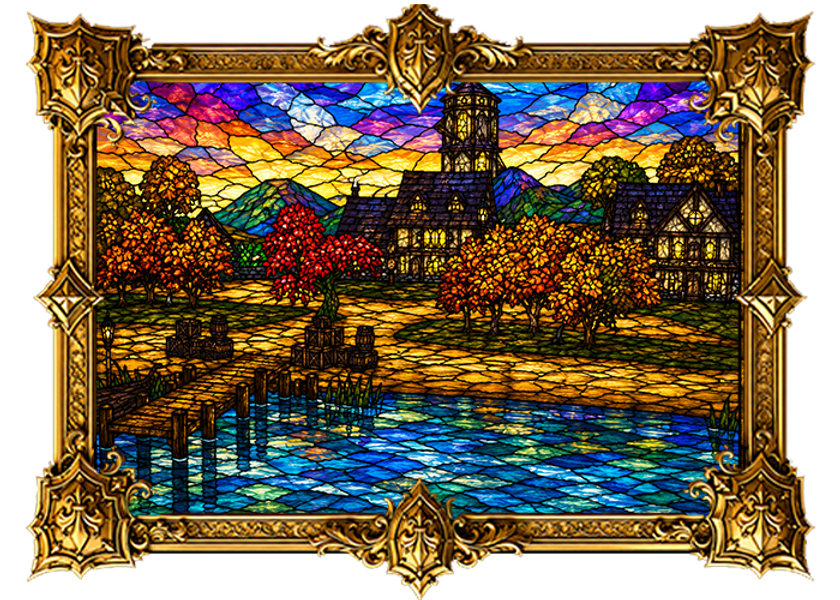
The Port Village of Vorakyn
The Jewel of the Western Coast
Nestled on the rugged western coastline of the Draconic Empire of Xytheria lies the Port Village of Vorakyn, a settlement whose influence reaches far beyond the modest title by which it is officially known. Although designated as a village within the Imperial census, Vorakyn has grown over the centuries into the second largest maritime settlement in the Empire, surpassed only by the magnificent Imperial harbors surrounding the capital city of Aurelith. Its natural harbor, sheltered between towering sea cliffs and protected by ancient breakwaters, has allowed the settlement to flourish into one of House Xytheris' greatest economic strongholds. Every day, merchant vessels bearing foreign banners glide into its waters carrying goods from distant kingdoms, while Imperial warships depart its docks to patrol the western seas under the authority of the Dragon Emperor. To countless travelers, Vorakyn is the first glimpse they receive of Xytherian civilization, and the village has become renowned throughout the continent for its prosperity, hospitality, and unwavering loyalty to the Imperial Crown.
From the first light of dawn until long after the moon has risen, Vorakyn is alive with constant movement. Fishing vessels depart before sunrise while the stars still linger overhead, returning hours later with nets overflowing with cod, silverfin, moon eel, and deepwater shellfish harvested from the rich western currents. Dockworkers labor tirelessly as cranes unload timber, marble, ore, textiles, spices, and countless other commodities arriving from every corner of the known world. Merchants shout prices across crowded streets while sailors exchange stories gathered during months spent on distant seas. The rhythmic ringing of blacksmiths' hammers echoes from nearby workshops, blending with the cries of seabirds circling above the harbor. Unlike many settlements whose activity fades with the setting sun, Vorakyn rarely sleeps. Ships arrive at every hour, taverns remain lively well into the evening, and lanterns illuminate the waterfront throughout the night, creating the impression that the village itself never truly rests.
The prosperity of Vorakyn rests almost entirely on trade, and nowhere is this more apparent than within its renowned Grand Market. Stretching across the central district beside the harbor, the marketplace has become one of the busiest commercial centers in western Xytheria. Dragon-forged weapons crafted in the great foundries of Aurelith are sold alongside delicate silks imported from distant eastern realms. Exotic spices, medicinal herbs, enchanted jewelry, navigational instruments, maps, books, rare wines, and finely carved sculptures occupy countless storefronts that line the streets. It is commonly said among travelers that if an item cannot be purchased within the markets of Vorakyn, it likely cannot be found anywhere within the Empire.
The village has also become celebrated for its remarkable hospitality, a quality that has evolved naturally through centuries of welcoming travelers from every imaginable corner of the world. Among its most beloved establishments is the Peddlers Inn, a large stone building overlooking the harbor whose reputation for exceptional food, warm lodging, and generous hospitality has spread far beyond the borders of Xytheria. The inn serves as a gathering place where merchants negotiate contracts, adventurers seek employment, scholars exchange discoveries, and weary sailors rest before embarking on another voyage.
The surrounding landscape possesses a rugged beauty that has inspired Imperial artists and poets for generations. High cliffs covered in evergreen forests overlook the sea, while winding streams descend from the western highlands before emptying into the harbor. During spring and summer, wildflowers blanket the surrounding hillsides with brilliant color, and seabirds wheel endlessly above the crashing surf beyond the protective breakwaters. Inland roads connect Vorakyn to neighboring settlements and eventually to the Imperial highways leading toward Aurelith, allowing goods arriving by sea to be transported efficiently throughout the Empire. Many travelers describe Vorakyn as one of the most picturesque settlements in western Xytheria, praising the remarkable harmony between its thriving harbor and the dramatic coastline that surrounds it.
For all its beauty and prosperity, however, there exists an unspoken solemnity that quietly shapes the character of the village. Visitors often notice small customs that seem insignificant when viewed individually but become increasingly curious over time. Parents insist their children return indoors before darkness settles across the sea, regardless of how peaceful the evening may appear. Fishermen refuse to sail toward the eastern waters after sunset even during seasons when the richest fishing grounds lie in that direction. Elderly villagers pause briefly whenever they pass a weathered stone marker positioned at the edge of the eastern road, lowering their heads in silent acknowledgment before continuing their journey. None of these traditions are explained openly, nor are they discussed with outsiders except through vague references to respecting "the old ways."
Those who remain in Vorakyn for extended periods gradually learn that the villagers possess an unusually deep reverence for tradition. Ancient festivals continue to be observed with remarkable precision, seasonal ceremonies are attended by nearly every household, and customs whose original purpose has long since faded from memory are still performed without question. To outsiders these practices appear to be harmless remnants of local folklore, preserved simply because generations before them observed the same rituals. The people of Vorakyn rarely challenge that assumption. They have learned that curiosity often fades more quickly than fear, and there are some stories that the older generations believe should never be told carelessly.
The stewardship of Vorakyn has rested for nearly two thousand years in the capable hands of House Wayburt, one of the oldest noble families sworn to House Xytheris. Though lesser in status than the Imperial Dragon House, the Wayburts have earned immense respect through unwavering loyalty, disciplined governance, and generations of faithful service to the Crown. Their ancestral manor overlooks the harbor from a rocky hill rising above the village, allowing its towers to watch both the bustling docks below and the distant coastline stretching eastward. Every Lord and Lady of House Wayburt is charged with safeguarding the prosperity of Vorakyn, administering Imperial law, collecting harbor tariffs, overseeing maritime trade, maintaining the docks and shipyards, and ensuring that one of the Empire's greatest ports continues to thrive beneath the banner of House Xytheris.
To the merchants who conduct business within Vorakyn, House Wayburt is remembered as a family of capable administrators and honorable rulers whose decisions have transformed a humble fishing settlement into one of the wealthiest ports in western Xytheria. Their judgments are respected, their authority rarely questioned, and their loyalty to the Dragon Emperor has never wavered despite the countless wars, political upheavals, and dynastic changes that have shaped Imperial history. Every portrait displayed within Wayburt Manor depicts leaders who devoted themselves entirely to the welfare of the village, preserving its prosperity through wisdom rather than conquest.
Yet beneath the polished halls of Wayburt Manor lies a truth known only to the head of the family and to the Dragon Emperor seated on the Imperial Throne. Hidden deep beneath the manor is an ancient vault that predates the construction of the estate itself. Within its walls rest weathered Celestine tablets, dragon-hide manuscripts, and sealed Imperial records written by the earliest rulers of House Xytheris. Every newly appointed Lord or Lady of House Wayburt descends into this chamber alone upon inheriting their title, where they are entrusted with a secret that has remained hidden from the people of Vorakyn. They soon discover that their ancestors were never chosen merely because they were gifted governors or skilled merchants. House Wayburt was appointed for a far older purpose, one whose origins stretch back to the earliest days of the Empire and to an age when the western coastline was feared by dragons and mortals alike. Only after accepting this burden does each new ruler come to understand that the true duty of House Wayburt has never been to govern Vorakyn. Their true duty has always been to guard what lies waiting beyond the eastern shore.
The Fallen Shrines
Beyond the easternmost edge of Vorakyn, where the well-traveled roads give way to windswept cliffs, stands one of the oldest and most mysterious landmarks in the Draconic Empire. This secluded stretch of coastline is known simply as the Fallen Shrine, a name spoken with equal measures of reverence and caution by the people of Vorakyn. Unlike the lively harbor to the west, the shoreline surrounding the shrines is unnaturally silent. Waves seem to break more softly against the rocks, seabirds rarely nest nearby, and even the strongest coastal winds lose much of their force before reaching the ancient stone circle.
The shrines are formed from two immense monoliths. Each stone rises more than sixteen feet into the air and is unlike any natural rock found within Xytheria. Their smooth surfaces shimmer faintly beneath moonlight, while intricate runes spiral from their bases to their weathered peaks. Despite centuries of exposure to salt, wind, and rain, the inscriptions have never eroded, leading Imperial scholars to believe the stones were not carved by mortal hands. Ancient records preserved within House Xytheris instead claim that the monoliths descended from the heavens during an age before the founding of the Empire, embedding themselves deep within the coastline where they remain to this day.
Among the stones drift hundreds of pale green lights that appear shortly after sunset and vanish with the coming dawn. The villagers call them the Emerald Souls, believing them to be the lingering spirits of those who have lived and died within Vorakyn. During funeral processions, mourners often leave flowers, candles, and small personal belongings near the shrines in the hope that their departed loved ones will find peace among the silent lights. Whether these glowing apparitions are truly the souls of the dead or something far older has never been answered, and the priests of Vorakyn intentionally avoid offering certainty where none exists.
For generations the Fallen Shrines have been regarded as sacred ground rather than a place of worship. However, that does not stop the locals from praying there. Offerings of food, flowers, handcrafted trinkets, and treasured heirlooms are quietly left atop the stone altar before the stones, particularly during the changing of the seasons. Few villagers can explain why these customs began, only that their parents and grandparents insisted they must never be abandoned. Even House Wayburt continues these ancient rites without fail, for the oldest records preserved beneath their manor warn that forgetting the traditions of the Fallen Shrine would invite a darkness that neither dragon nor emperor could easily contain.
The oldest surviving records of House Xytheris speak not of a monster imprisoned beneath the Fallen Shrine, but of an existence so ancient that even the earliest dragons possessed no memory of its beginning. Within the weathered Celestine tablets preserved inside the Imperial archives, the entity is identified only as Nyxoraeth, a name that Imperial scholars have never translated with certainty. Among the priests of Vorakyn it is more commonly referred to as the Silence Beneath the Tide, for it is believed that wherever the being stirs, the sea grows unnaturally calm and every living creature instinctively falls silent. The villagers seldom utter either name aloud, believing that repeated speech invites the deity's attention, and many instead refer to it simply as the One Beyond the Shore.
Unlike the gods worshipped throughout the Empire, Nyxoraeth is not believed to possess dominion over any single aspect of the world, nor does it seek devotion in the manner of divine beings. The oldest Celestine writings describe it as a primordial intelligence that existed before the first kingdoms, before dragons ruled the skies, and perhaps even before the world itself had settled into its present form. It is neither male nor female, neither mortal nor immortal, and no account has ever agreed on its true appearance. Sailors who claim to have glimpsed the being from distant waters offer wildly different descriptions, each insisting that what they witnessed could not possibly be mistaken. Some speak of a towering figure draped in robes woven from sea mist, while others describe an endless silhouette whose reflection stretches farther across the water than the eye can follow. A handful of witnesses insist that Nyxoraeth has no form at all.
House Xytheris has long forbidden Imperial scholars from attempting to summon or communicate with the entity, for the earliest accounts suggest that Nyxoraeth possesses a profound influence over memory, grief, and the unseen boundary separating the living from the dead. According to these records, those who ventured too close to the ancient shoreline before the binding did not always perish. Some returned home unable to remember their own families, while others wandered the coast for days speaking in forgotten languages before disappearing into the sea without resistance. Entire fishing camps were said to have been abandoned overnight, their inhabitants leaving behind homes, possessions, and even loved ones as though compelled by a call that only they could hear.
Over countless generations the people of Vorakyn have learned not to regard Nyxoraeth with hatred, nor even with fear alone, but with solemn respect. They understand that whatever dwells beyond the Fallen Shrine is older than their village, older than the Empire, and older than the bloodline of House Xytheris itself. It is not worshipped because it grants blessings, nor because it demands obedience through spoken command. The offerings left upon the shoreline are instead acts of remembrance that acknowledge an ancient covenant whose purpose has long been forgotten by most of the village. Only the rulers of House Wayburt and the Dragon Emperor know the full truth, for they alone inherit the complete history of how Nyxoraeth came to rest beneath the Fallen Shrine and why its prison must never be allowed to fail.